
Divyanshi Sharda
Abstract
Socio-ecological systems thinking is a concept that approaches an ecosystem as one that is wholly integrated with the economy and social institutions of the given region. This conceptual framework can offer interesting insights into fragile ecosystems of India’s Western Ghats, specifically in the Kodagu region, renowned for their vast coffee agroforestry economy. This secondary qualitative analysis uncovers the intricate interlinkage and mutual feedback loops between Kodagu’s coffee agronomy, indigenous Hindu religious traditions and the endemic ecology of the Western Ghats, and how this integrated holistic system faces severe threats from commercialisation, pollution and injudicious agricultural land expansion. The commentary further identifies certain helpful policy recourses to mitigate this socio-ecological detriment, including but not limited to the incentivisation of organic produce and a more democratised administration.
1. Introduction: The Endemic Ecological System of Kodagu’s Western Ghats
Kodagu district is located in Karnataka’s western ghats and is a biodiversity hotspot that provides a wide range of items to the local community. The ecology coexists with the social and economic aspects in this setting, establishing a holarchic interaction.1 The Kodagu Forest is maintained by communities, the Karnataka Forest Department, and diverse stakeholders using a psycho-spiritual approach, since a significant portion of the forest is covered with sacred groves that are worshipped and preserved by the local Hindu population.2 A large portion of the forest, 32%, is covered with coffee agroforestry, which creates a positive feedback loop in the ecosystem. Approximately 8 percent of the land is used for agriculture purposes. The sacred groves have a high density in the region – one grove every 300 Ha.3 Additionally, with between 1600 and 1700 elephants present, Kodagu serves as an important route for elephant mobility between the northern and southern reaches of the Mysore elephant reserve4 and its agroforestry lands provide locals and wildlife conservationists landscape connectivity with endangered animal species by ensuring a radical openness of the ecology, mainly manifesting as porous boundaries between human and animal set. However, detrimental tendencies are being detected in this area as a result of unsustainable tourism and encroachment of forest land owing to excessive agricultural activities, which need to be addressed with a recourse of effective policy solutions.
1.1 Fundamental Concepts of Complex Adaptive Systems Found in Kodagu’s Ecosystem
Complexity theory is most readily applicable in the natural world, where concepts of adaptation, resilience and intricate interconnectedness are abundantly observed. Ambika and Kurths (2021) provide a succinct explanation of the nature of tipping points within a complex system, and how they characterize the final stage or threshold of the system after which it experiences a dynamic, consequential and often irreversible shift that facilitates its transition into another existential state altogether. Juarrero (2023) talks about the unique arrangement of a holarchy and draws on Arthur Koestler’s conceptualization of holons to describe the “compositional” relationship shared by the elements within a holarchic structure. The aforementioned scholarly works on the fundamental concepts of complexity theory are accompanied by the research on self-organization, which is incisively defined by Nederhand et al. (2014) as the process of different actors or elements collectively communicating and engaging in mutual adjustment; thereby giving rise to larger, systematically operating institutions. A lucid explanation of feedback loops is given by Meadows (2009) where the author describes their function as reinforcing or balancing – depending on whether they increase or decrease the magnitude of a particular phenomenon, process or object. Lastly, Willy et al. (2003) elucidate the nonlinearity of complex adaptive systems as an inalienable feature of the same which entail the production of impacts highly disproportionate and unprecedented on the entirety of the system due to a change in any of its sectoral elements.
Such characteristic aspects of complex systems are abundantly observed in the socioecological system of Kodagu. An important principle applicable here is the inherent adaptability to preclude tipping points. Nature has the inherent capacity to avoid tipping points and act as a self-sustaining ecosystem. In the Kodagu region, agroforestry and coffee plantations keep in check these tipping points, if they follow the traditional practices of incorporating the native vegetation. Secondly, the principle of non-linear effects of anthropogenic activities is also observable. In 2019, Kodagu was affected by severe floods aggravated by pollution and soil erosion, suggesting that anthropogenic activities can have a series of highly disproportionate and unexpected effects on the ecosystem. Other aspects such as self-organization and feedback loops operating within the system will be discussed in the findings of the paper.
2. Methods
Socio-ecological Systems are comprehensive organically evolved structures which encompass not just the environmental resources, but harbour within themselves the very establishment of human institutions of society and the economy as well; the latter which exist as intrinsic components and not mere coordinating agents of the ecosystem. The goal of this research is to investigate the Kodagu Forest natural and anthropogenic ecosystem in the Western Ghats of Karnataka through a complex adaptive lens, using its many features to comprehend the interactions between the environment and the local community, employing the methodology of secondary qualitative analysis. The theoretical framework of complex systems-thinking allows us to view Kodagu’s Western Ghats as an intricate socio-ecological system where human-made institutions of economic development and rural livelihoods are deeply nested within the broader tropical climate, biodiversity and evergreen rainforest vegetation of the Western Ghats mountain range, and are thus not only configured by the climate of the region, but are also protected by the same, particularly in the case of local coffee agroforestry sector, which is heavily benefitted by Kodagu’s native vegetation. Additionally, the complex systems thinking framework also enables us to observe the multiplicity of the ways in which changes within the economic system can produce starkly disproportionate, nonlinear modifications within the greater ecological sphere. This profound relationship is most accurately captured by the aforementioned complex systems-thinking epistemology and therefore the latter has been employed for this research.
In accompaniment with the scholarly work on the fundamental concepts within complexity theory, this research also engages in an in-depth review of literature on the socioeconomic profile of the Kodagu region, with a primary focus on the coffee agroforestry industry and its intricate interaction with the ecological system of Southern Karnataka state’s Western Ghats. The same methodology was also utilized to identify some key challenges facing the region and its coffee industry today, in addition to a thorough engagement with some evidence-based policy solutions that could be offered to mitigate these challenges. The technique undertaken to conduct this review of literature was largely a qualitative one, as it not only disaggregates the structure and operation of this socio-ecological system but also the policy solutions offered to the problems it faces into non-numerical themes largely grounded on the different sectors of public governance. It simultaneously employs theoretical frameworks of complexity to bring the inferences and findings, collected digitally through the aforementioned secondary review of literature, into perspective.
The paper is divided into five sections. The first encompasses an introduction to the geographical region of Karnataka state’s southern district of Kodagu, and delves into the methodology used in the research. The subsequent section is focused on the findings; starting from the indigenous Hindu administrative institutions which are intricately woven with and protect the ecology of the region, followed by a specific focus on the industry of coffee agroforestry which not only incorporates the aforementioned administrative institutions but also showcases the characteristic feature of adaptability within a complex system, in this case Kodagu’s ecology and the socioeconomic subsystems which are nested within it, as a relatively recent coffee industry – introduced during the colonial British era – has been reconfigured by the local agricultural population in the form of a structure that exists symbiotically with the ecology instead of developing at the cost of it, by tapping into indigenous knowledge systems emphasizing on evidence-based sustainable agricultural practices and Dharmic institutions of sacred groves for nurturing the native biodiversity. Such a subdivision of the third section has been undertaken in order to render the different sectoral elements and their interaction within Kodagu’s socio-ecological system more easily understandable, starting from the region’s ecology, succeeded by an elaboration on the methods adopted in the paper, then moving towards the social institutions of natural resource governance, lastly followed by the economic sphere of the coffee industry. This discussion is succeeded by the subsection on the problems affecting the ecological balance of Kodagu through unsustainable and uncontrolled pathways of economic development, followed by a broad section deliberating upon the policy solutions – ecological, economic and administrative – that could be adopted by the government, in close cooperation with the local population, to mitigate the aforementioned challenges, followed lastly by the fifth concluding part of the paper.
3. Findings
3.1 Complex Institutions of Co-operative Management
The district has 1,214 sacred groves – which also provide resources and forest produce for the local communities – that cover an area of 2500 Hectares.5 These sacred groves, known natively as Devarakadus, are protected and revered by the communities through traditional knowledge systems, which are effective strategies of forest conservation, as a significant number of endangered trees within Kodagu’s Western Ghats are found in sacred groves.6 Hindu religious traditions facilitate psycho-spiritual processes of self-organization7 in which local communities derive utility from forest conservation while also providing services to the forest, showcasing a starkly non-neoclassical approach to ecological services. The groves are worshipped as loving deities, ancestral beings and elders of the family – who nurture the local population and the surrounding ecology like parents caring for their children, which is naturally reciprocated by the locals through biodiversity conservation undertaken as a demonstration of their love and familial bond with their divine elders. The traditional Hindu worldview does not demarcate between the natural world and humankind as separate institutions, but in fact views all of existence as part of the same sacred family, and this perspective extends into the collective management of the groves, which are in some cases located within coffee plantations8, and not only provide a good support system to coffee production, but also act as a good source of forest produce, such as fruits. In cases where the sacred groves are not located within the coffee plantations, they still continue to function as pollination sources facilitated by the giant Asian honey bee, which also helps significantly increase the coffee yield.9 This has led to the creation of porous boundaries between human institutions and the ecosystem, as their religious institution is the ecosystem itself. The community also assists the Forest Department by cooperatively developing micro plans; nevertheless, due to red-tapism and administrative mismanagement, the plans are frequently rescinded.
The majority of the coffee fields are used by small producers with less than 10 hectares of land. Two kinds of coffee lands are observable: unredeemed and redeemed. The trees in unredeemed sections of the Kodagu coffee estate are controlled by the government, with the ownership in the planter’s hands. In the case of redeemed land, the planters own both the land and the trees. Unfortunately, due to the strategy of plantation adopted, more than 10,000 hectares of forest land has been lost.10 To overcome this, the government has adopted an incentive system to encourage afforestation of farmlands, such as Krushi Aranye Protsaha Yojane (KAPY) along with earlier conditional payment policies which entailed money being transferred to farmers for preserving the forest land on their plantations. However, this could prove counterproductive, since the money given by the government against deforestation might be used by farmers as capital to clear more forest land for coffee agriculture, expand their plantation and become more affluent; since evidence indeed shows that farmers clear off forest patches from agricultural land the moment capital is available.11 Negligible data is available regarding efficacy of such cash transfer programmes, while KAPY has experienced a greater level of success.12
3.2 Relational Constitution Between Coffee Agroforestry and the Ecology of Kodagu
While the economic landscape of Kodagu’s Western Ghats is dominated by the two sectors of Agroforestry and Tourism, it is coffee agroforestry which is Kodagu’s claim to international fame, providing livelihood to 51% of the total workers.13
Coffee agroforestry in Kodagu contributes to 35% of India’s overall coffee production.14 It is a perfect example of a constructive feedback loop15 that creates a sustainable development template; since it not only contributes to protecting the native biodiversity of the region, but also provides economic sustenance to an overwhelming proportion of Kodagu’s locals through its multidimensional nonlinear chain of effects.16 This chain manifests in a structure explained and graphically depicted through the diagrammatic representation given below.
Firstly, coffee shrubs are always reliant on taller shade-providing trees with sizeable canopy size that provide suitable thermal conditions and improve the soil’s essential nutrient content for inducing growth of good quality coffee. In Kodagu, the traditionally cultivated Arabica coffee and the relatively new Robusta coffee are reliant on the native large-canopied shade-providing trees. These companion plants create an optimum temperature for coffee growth and prevent attacks from destructive pests such as the Berry Borer, as the cool temperature is not suitable for pest breeding, accompanied by the fact that these estates have high native tree species richness.17 The interdependent heterogeneity of components is also observable through the fact that the presence of diverse native trees induces growth of beneficial insects that eat the harmful pests. If pest resistance is an important biotic process propelled by native trees, then adequate moisture prevalence in the soil is a significant abiotic contribution by the same.
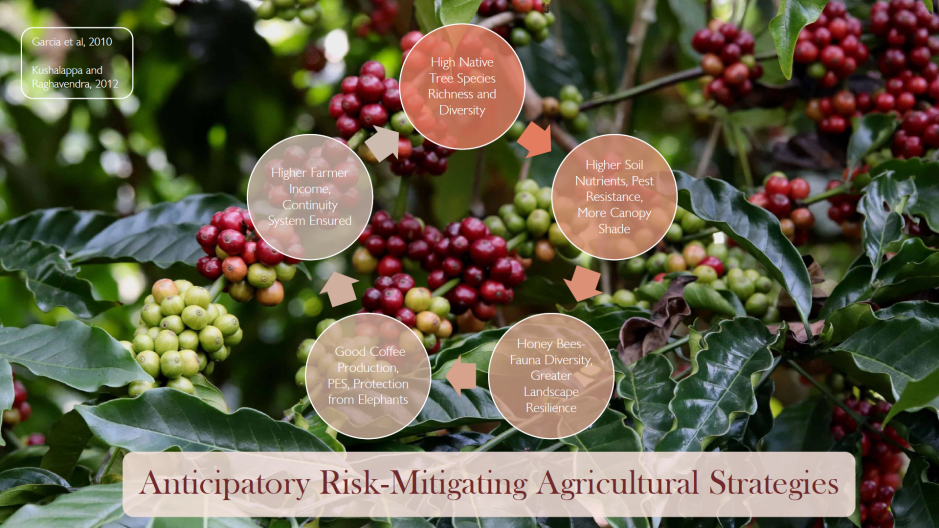
Moreover, the diverse native shade trees also increase the microbial activity in the soil, enriching it with nutrients which are conducive to an abundant coffee production.18 In fact, it was even recorded that retention of native trees in agroforestry of both species of coffee (Arabica and Robusta) has had a positive impact on the productivity of coffee beans in both redeemed and unredeemed estates, thereby leading to stable farmer income and jobs, and incentive for planting or retaining more native trees.19
The native giant honey bee, primarily responsible for pollination in the Indian subcontinent, prefers building its home in the large canopy offered by the native shade trees. This leads to a greater rate of pollination in the coffee fields harbouring forest patches, which ensures germination of double-beaned coffee instead of incomplete single-beaned coffee. The complex emergence of the ecosystem is beautifully observed with each component (native trees, honey bees, beneficial insects, soil microorganisms) working in symbiosis, therefore collectively embodying properties of a thriving tropical evergreen ecosystem as a whole, wherein the conditions have instinctually evolved with perfect assurance of exactly what each component requires to survive and thrive. This is key to understanding that such precious components cannot survive if they are isolated from their native environment and introduced into an alien landscape. Their inability to adapt to existing ecological conditions will not only lead to self-destruction but also the degradation of the larger ecosystem as well. This implies that such components might have autonomous properties (which differ from one another in their specificities) but are heavily interdependent for their collective survival.
3.3 Difficult Trends of Ecological-economic Interlinkage
The aforementioned case of environment degradation due to absence of adaptability of alien species into an ecological system is evident through the adoption of an exotic, marketable Australian tree species, Grevillea robusta. A shade-giving tree, although beneficial for farmer profits as it can be used for commercial sale of timber, is disastrous for the endemic biodiversity of the region;20 it weakens the soil resilience to surface run-offs, erosion and makes it prone to landslides, apart from acting as a host to pests and diminishing the pollinator population through its smaller canopy.21 This is a destructive feedback loop, as it increases the rate of change of ecological degeneration manifold. This uproots the healthy continual adaptation that the Western Ghats had exhibited while accommodating the growth of coffee cultivation (which expansively began during colonial times) and providing socio-ecological mechanisms to retain its biodiversity via the avenue of sustainable livelihoods itself.
Secondly, the tourism sector, which employs 21% of the local population, is another destabiliser of the vulnerable ecosystem as it causes 80-95% of freshwater pollution, alongside an approximate 27% of biodiversity loss and deforestation.22 Unfortunate disadvantageous effects are observed in terms of labour shortage for middle-income and low-income farmers during tourism months, as farm workers prefer to temporarily work in small-scale tourist shops and hotels because of better income. This causes high labour cost and subsequently low farmer income. Moreover, this pushes the farmers even more towards the usage of chemical fertilisers and pesticides, and inorganic farming in general, which is less labour-intensive and relatively inexpensive, but once again destructive for the interactive ecology. This displays the drastically different relational constitution of the Tourism industry with Kodagu’s Western Ghats in comparison to coffee agroforestry; with the latter at least providing a relatively successful specimen of eco-sensitive livelihoods.
Excessive expansion of coffee estates into forest lands is now a grave threat as well, since around 30% of forest patches were cleared by primarily private (often corporate) coffee estate owners within a span of two decades, 1977-1997. Utilisation of firewood by the marginalised communities for fuel and energy usage is also a factor worth considering with regards to deforestation of native trees; even more so since such groups are too socio-economically disadvantaged to have the opportunity to plant multipurpose trees on farms as an alternative to firewood since they are mostly landless.
4. Discussion: Policy Recommendations Based on the Findings
Certain necessary policy suggestions to address some of the key challenges discussed above can be taken into consideration, which are as multidimensional as the issues encountered and equally holistic in their implementation trajectory.
4.1 Economic and Financial Resources
Certain directives of market adjustments are extremely significant, particularly vis-à-vis government intervention in the pricing mechanism of farm products. The foremost decision which the state administration in partnership with the private companies and various supply-chain stakeholders should prioritise is the provision of a premium for local organic coffee. Although organic production is generally more expensive, many low and middle-income farmers of Kodagu are unable to access such lucrative markets due to high input costs involved in the process of organic farming, as it is more time-consuming, less productive in the same time-span, and labour-intensive. Unless there is a significant premium that is offered to farmers opting for organic means through market intervention, there would be no practical incentive for them to stop the usage of harmful synthetic fertilisers and pesticides. Similarly, there needs to be a regulatory stringency for farmers having redeemed lands (which have more exotic and lesser native trees) to re-introduce native shade-trees for coffee bushes.
In the case of tourism, the decision of government sponsorship of only eco-sensitive tourism companies (eg. Mojo Plantation Rainforest Retreats) and units could be considered in accompaniment with penalties for those service providers which have been noted for abetting ecological pollution and degradation. Prioritisation of local community-led tourism industries (since the contemporary sector employs a considerable number of non-locals) in the form of co-operative enterprises with a limit to the number of annual tourists in the region could be an effective solution as well.
4.2 Ecological Welfare Initiatives
Since agroforestry polyculture is a strong merit of Indian coffee plantations, this can be further augmented through encouragement of local farmer communities to cultivate the native Adi Pepper of the Western Ghats, which is not only reliant on greater incorporation of native trees – since it was earlier grown for domestic purposes on native trees only – but can also survive on much less water.23 It is drought tolerant and disease resistant, and even brings in approximately six times more profit as compared to other species of pepper cultivated in Kodagu.24 This will not only help preserve biodiversity but will also reap immense farmer profits.25
Elephant rampage is a big issue in the agroforestry plantations of Kodagu since the forest patches present in the coffee fields attract elephants, who end up destroying more than Rs. 8,00,000 worth crops annually alongside 3-10 human fatalities. As observed in the neighbouring state of Kerala and even North Bengal, apiculture can be a good tool to keep elephants away, as evidence suggests that this practice repulses them.26 This is also a non-violent method of repelling elephants, and possibly a better alternative than solar-wired fences, which might injure or even kill the elephants. This process will simultaneously benefit effective pollination as well and automatically contribute to conservation.
4.3 Administrative Measures
Making forest administration and law enforcement agencies in the district more indigenous-local centric by employing as many people from the forest-dwelling and impoverished rural communities as possible would instill greater sensitivity, accountability and integrity in operations as members from such groups are worst impacted by any ecological crisis in such vulnerable locations. The disconnect and corruption prevalent in administrative bodies due to the greater composition of non-locals will be mitigated in this way.
Agroforestry lands should be converted to unredeemed from redeemed lands as much as possible since studies have proven the greater existence of native shade trees in unredeemed lands as compared to redeemed lands, as the forest department will have direct control over the endemic trees in such estates.
Corporate coffee companies, although having provided mass employment opportunities, have also abetted extensive forest land reduction for plantation expansion purposes, leading to heavy biodiversity loss. Such multi-millionaire corporations have to be kept in check by putting strict restrictions on further forest clearance and empowering smaller farmer cooperatives engaged in coffee production and consolidated land ownership.
5. Conclusion
It is duly noted that the treasured socio-ecological system of Kodagu is in need of immediate attention, primarily to prevent further biodiversity loss, and secondly to regenerate unproductive, barren lands. Through a complex adaptive systems lens, it proves to be an educative study of how the economy and administration has to be viewed not as a mere coordinating domain, but rather an inherent component within the broader ecology.
- A holarchic arrangement consists of broad sectors acting as elements that are nestled within each other, each forming both a whole in itself as well as a part of the larger system it resides in (Juarrero, 2023). These elements are highly interconnected and interrelated, resulting in an alteration or change in the entire system as a subsequent effect of any dynamic activity occurring within any of the constituent elements. The demarcations between such elements are largely blurred, as certain characteristics and impacts of these sectoral elements travel and intermix with those belonging to both larger sectors which encompass them and also to smaller sectoral elements encompassed by them. An automobile industry operated by the middle-income communities of majorly belonging to one ethnic group in a coastal region could be understood as a good example of a holarchy; starting from the smallest anthropogenic institution that is the economic arrangement of an automobile industry, enveloped by an older, more widespread institution of social groups, ethnicities, kinship systems and cultural norms, being completely nestled within the larger, overarching coastal climate, biodiversity and even the ecosystem services provided by the natural environment such as a relatively flatter coastal terrain and a renewable source of energy for the automobile industry through utilisation of tidal power. ↩︎
- Bhagwat, Shonil A., Cheppudira G. Kushalappa, Paul H. Williams, and Nick D. Brown. “The role of informal protected areas in maintaining biodiversity in the Western Ghats of India.” Ecology and Society 10, no. 1 (2005). ↩︎
- Ibid. ↩︎
- Ramachandra, T. V., Setturu Bharath, and S. Vinay. “Visualisation of impacts due to the proposed developmental projects in the ecologically fragile regions-Kodagu district, Karnataka.” Progress in Disaster Science 3 (2019): 100038. ↩︎
- Kushalappa, C. G., and S. Raghavendra. “Community-linked conservation using Devarakad (sacred groves) in the Kodagu Model Forest, India.” The Forestry Chronicle 88, no. 3 (2012): 266-273. ↩︎
- Kushalappa, C. G., and S. A. Bhagwat. “Sacred groves: biodiversity, threats and conservation.” Forest genetic resources: status, threats, and conservation strategies. Oxford and IBH, New Delhi (2001): 21-29. ↩︎
- Nederhand, Jose, Victor Bekkers, and William Voorberg. “Self-organization and the role of government: how and why does self-organization evolves in the shadow of hierarchy?” Rotterdam: Erasmus University Rotterdam (2014). ↩︎
- Raghava, Major. “Sacred Groves and Cultural Practice in Kodagu.” International Journal of Research and Analytical Reviews, September 2016, Volume 3, Issue 3 (2016). ↩︎
- Warrier, Gopikrishna S. “Sacred groves of Kodagu: How faith is helping conserve Karnataka’s protected forests.” The News Minute. (2017). https://www.thenewsminute.com/delve/sacred-groves-kodagu-how-faith-helping-conserve-karnatakas-protected-forests-64240 ↩︎
- Ministry of Environment, Forest and Climate Change. “State of Forest Report.” Forest Survey of India. (2021). ↩︎
- Garcia, Claude A., Shonil A. Bhagwat, Jaboury Ghazoul, Cheryl D. Nath, Konerira M. Nanaya, Chepudira G. Kushalappa, Yenugula Raghuramulu, Robert Nasi, and Philippe Vaast. “Biodiversity conservation in agricultural landscapes: challenges and opportunities of coffee agroforests in the Western Ghats, India.” Conservation Biology 24, no. 2 (2010): 479-488. ↩︎
- A, Naina J. “Krishi Aranya Protsaha Yojane is a hit in rural areas.” Deccan Herald (2012). https://www.deccanherald.com/content/257899/krishi-aranya-protsaha-yojane-hit.html ↩︎
- Ministry of Commerce and Industry. “Coffee Area Details of The Kodagu District.” Government of India. (2022). ↩︎
- Cheppudira, Kushalappa, Philippe Vaast, Yenugula Raghuramulu, Claude A. Garcia, and Fergus L. Sinclair. “Coffee agroforestry in Kodagu, western ghats, India-need for conservation to sustain livelihoods.” (2010). ↩︎
- Meadows, Donella H. “Thinking in Systems: A Primer.” London ; Sterling, VA: Earthscan (2009). ↩︎
- Willy, Christian, Edmund AM Neugebauer, and Heinz Gerngroß. “The concept of nonlinearity in complex systems: An additional approach to understand the pathophysiology of severe trauma and shock.” European Journal of Trauma 29 (2003): 11-22. ↩︎
- Nandita. “An Agroforestry Scientist’s Notes on Kodagu and Climate Change.” The Life of Science. (2019). https://thelifeofscience.com/2019/09/18/an-agroforestry-scientists-notes-on-kodagu-and-climate-change/ ↩︎
- Ibid. ↩︎
- Shruthy, MK Gana. “Does Land Tenures Affect Productivity of Coffee? Farm Level Evidences from Western Ghats of India.” Research Journal of Agricultural Sciences. (2021). ↩︎
- Garcia, Claude A., Shonil A. Bhagwat, Jaboury Ghazoul, Cheryl D. Nath, Konerira M. Nanaya, Chepudira G. Kushalappa, Yenugula Raghuramulu, Robert Nasi, and Philippe Vaast. “Biodiversity conservation in agricultural landscapes: challenges and opportunities of coffee agroforests in the Western Ghats, India.” Conservation Biology 24, no. 2 (2010): 479-488. ↩︎
- Nesper, Maike, Christoph Kueffer, Smitha Krishnan, Cheppudira G. Kushalappa, and Jaboury Ghazoul. “Shade tree diversity enhances coffee production and quality in agroforestry systems in the Western Ghats.” Agriculture, Ecosystems & Environment 247 (2017): 172-181. ↩︎
- KM, Anil Kumar. “Socio-Economic and Environmental Impact of Tourism in Kodagu District (India): A Case Study.” Universal Journal of Environmental Research & Technology 5, no. 1 (2015). ↩︎
- Adi Pepper, “About.” (2025). https://www.adipepper.com/about#:~:text=Adi%20pepper%20is%20one%20such,maintenance%2C%20and%20is%20disease%20resistant. ↩︎
- The New Indian Express. “Kodagu farmer wins award for conservation of native pepper crop.” (2021). https://www.newindianexpress.com/states/karnataka/2021/Nov/18/kodagu-farmer-wins-award-for-conservation-of-native-pepper-crop-2385141.html ↩︎
- Ibid. ↩︎
- Thomasy, Hannah. “Beehive fences can help mitigate human-elephant conflict.” Mongabay. (2019). https://news.mongabay.com/2019/09/beehive-fences-can-help-mitigate-human-elephant-conflict/ ↩︎
Biography
Divyanshi Sharda is a Public Policy graduate from the Jindal School of Government and Public Policy, O. P. Jindal Global University. She enjoys studying development policymaking, community-centric governance and social infrastructure consolidation. She can be reached at divyanshi.sharda@gmail.com.
 gradfoodstudies.org