

Fulvia Larena
In the second chapter of the film Caro Diario, a young Nanni Moretti walks across a muddy football field. Behind him, the old houses are worn by the sea air; in front of him, a small lake is separated from the sea by rows of stones. We are in Salina, one of the seven Aeolian Islands, a volcanic archipelago off the northern coast of Sicily, Italy. Moretti deserves credit for portraying the Aeolian Islands with a disenchanted gaze, attempting to break the idyllic image still surrounding them. However, what Moretti does not tell us is that this small patch of land in the village of Lingua, bears witness to a fundamental chapter in the island’s economic history—once so prosperous that it was divided into three independent municipalities, unlike the rest of the Aeolian Islands, which were all under the Municipality of Lipari.
It was around 1935 when Alberto Tobia arrived in Salina1, chasing the raw material of his family business: ‘a ciciredda (sand smelt 2), an endemic Mediterranean fish no longer than 15 cm, with a long, straight body and smooth skin, appearing in winter to lay its eggs on the seabed and surfacing at night to feed.

Photo taken during the research residency Gastronomic and Cultural Adaptation to Climate Change in Mediterranean Island Areas: An Ecocritical and Participatory Analysis, at Fondazione Studio Rizoma, Palermo, Italy.
The Tobia family, originally from a town called Noli in the region of Liguria, were fishermen who specialized in the production of ciciredda in vinegar. They followed this fish wherever it was abundant. After the initial scouting trip, Alberto established a plant in Salina, creating a thriving winter industry that involved much of the local population, generating work and prosperity for the island.
Each year, the Tobia family set sail for Salina after the Feast of the Immaculate Conception (8th December), residing there until March, when the fishing of bigger fish marked the arrival of spring. Local fishermen, mainly from Salina and Lipari, were responsible for catching the fish. The gozzi (small fishing boats) set out between 3:00 and 4:00 AM, and whoever arrived first had the right to the first cast of the sciabica, a net thrown directly from the boat. Once the fishing was done, they returned to the Lingua plant—right where Nanni Moretti kicked his ball—where the catch was weighed in spase, traditionally baskets with handles.
Then, the frantic activity began. The Tobia family bought about 150 kg of fish per boat, but the catch was so abundant that plenty remained for the fishermen. The ciciredda was laid out on large frames brought from Liguria, placed in rows in the field (see below) at dawn, and entrusted to pairs of women who dried the fish with rhythmic movements like a dance. If the weather was bad, the frames were moved to the essiccatoio (a machine to mechanically dry fish), a metal structure equipped with propellers to aerate the fish. Once dried, the fish was ready to be fried, a task carried out by at least three men at each station, while a swarm of children hovered around the copper cauldrons, waiting for a hot bite.

Photo taken during the research residency Gastronomic and Cultural Adaptation to Climate Change in Mediterranean Island Areas: An Ecocritical and Participatory Analysis, at Fondazione Studio Rizoma, Palermo, Italy.
The frying took place over wood-fired stoves, where 90 cm-wide cauldrons bubbled, filled with strictly olive oil. The fish was drained with large skimmers and placed in baskets near the pot, allowing excess oil to drip through a drainage tube and be reused for multiple batches. Each batch of oil fried about 5 kg of fish. When the weather allowed, frying occurred outdoors, becoming a celebration and community gathering moment.
The fried ciciredda was then placed in large wooden barrels—similar to wine barrels—and preserved in vinegar. The barrels were shipped to Naples and then to Liguria, where the fish was canned and prepared for distribution.
The launch of the Tobia plant immediately led to great excitement around the activities related to it. Especially during winter, all of Salina revolved around the ciciredda. The fishermen caught the fish, the carpenters supplied wood for the stoves and barrels, the women handled the drying, and the children lingered, waiting for a golden snack. According to the people of Salina, the Tobia family were excellent redditusi (holders and distributors of wealth), actively contributing to the industry and island life by generously giving away fresh or fried fish and even powering the community’s cinematograph nights with the generator from the essiccatoio.
Elbano Tobia, the last member of the family to run the business until around 1965, embodied this spirit of integration. He married Pina Costa—known as Giuseppina—a woman from one of Salina’s historic families. In 1966, they opened a guesthouse called La Marinara, which also housed a pizzeria built within the old cicciredda plant. Over the years, this humble space evolved: in 2005, it became the renowned Ristorante d’Alfredo. The guesthouse itself was later sold to Mr. Santino Ruggero3, who transformed it into today’s Il Canneto guesthouse.
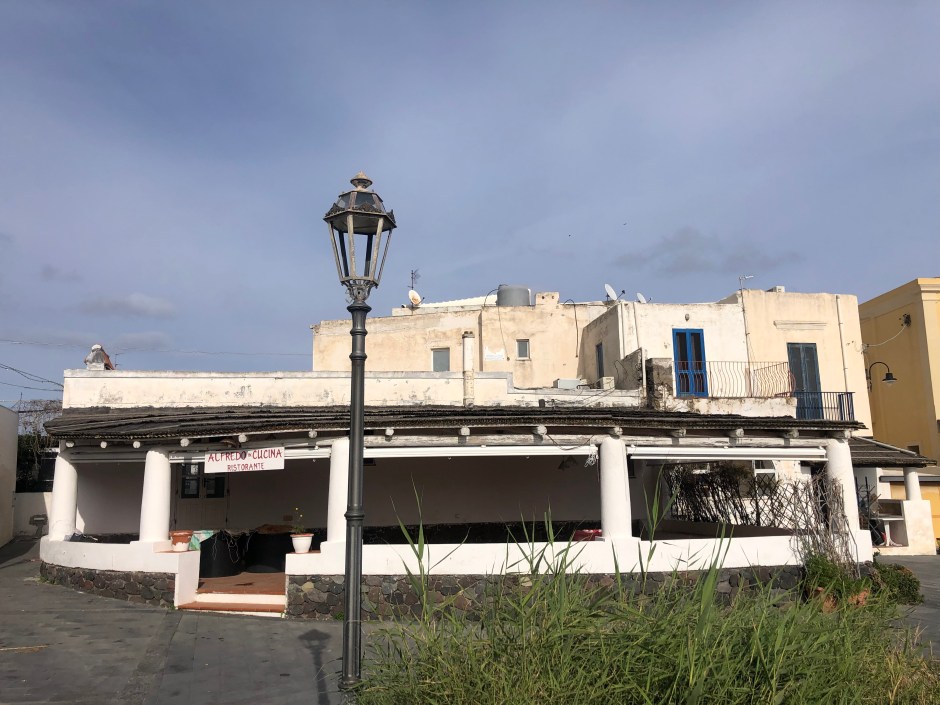
Photo taken during the research residency Gastronomic and Cultural Adaptation to Climate Change in Mediterranean Island Areas: An Ecocritical and Participatory Analysis, at Fondazione Studio Rizoma, Palermo, Italy.
That muddy football field, where Nanni Moretti plays with his ball, is all that remains of this once-thriving industry. The fishing of ciciredda, which lasted until around the 1970, has almost disappeared due to climate change and environmental degradation affecting the Aeolian waters. Rising sea temperatures and coastal erosion have made the sea increasingly inhospitable for many species, including the ciciredda. Once abundant, this small fish has become a rarity: only a few kilos are found each year, never exceeding 10 cm in length, and the price ranges between 25 and 30 euros per kilo 4.
The people of Salina and Lipari still hold the memory of the fritta d’a ciciredda and of Elbano Tobia, who, after closing his business, wandered along the Lingua waterfront and around his old plant, always wearing a hat, an earring, and a cigarette in his mouth—earning him the nickname The Pirate.
The decline of fishing has also marked an economic shift for the island, which has now turned to tourism, adapting to an increasingly depleted marine environment. Today, Salina—and the Aeolian Islands—attract travelers searching for beauty and authenticity. Still, the sea surrounding them differs significantly from the one that once nourished its people. This is something that should not be ignored.
The story of the ciciredda thus becomes the story of a changing ecosystem and a community striving to adapt to an evolving world. Reflecting on the memory of this tradition should spark a broader discussion about the challenges that climate change imposes on local knowledge: how can we preserve natural resources, protect biodiversity, and support the communities that depend on them?
- The information that made it possible to write this narrative comes from oral sources collected during a three-month residency in the Aeolian Islands, as part of the research project Gastronomic and Cultural Adaptation to Climate Change in Mediterranean Island Areas: An Ecocritical and Participatory Analysis, carried out at the Fondazione Studio Rizoma in Palermo. ↩︎
- The Italian classic name for this fish is cicirello (Gymnammodytes cicerellus in latin). While ciciredda is the common Sicilian name for it. ↩︎
- As the current owner of the building formerly belonging to Elbano Tobia, Santino Ruggero is the person who has provided the most documentation related to this story, particularly regarding the dates of the various openings and sales of the properties mentioned. ↩︎
- As it is visible in the first picture. ↩︎
Biography
Fulvia Larena works at the intersection of research, cultural planning, and the production of cultural and artistic events and content. Her experience spans both independent initiatives and institutional entities. Her research focuses on food as an effective tool for exploring the world and understanding its complexities through a perspective rooted in local territories and their regionalisms. She engages with artistic practices and visual projects that use food to examine the controversies of contemporary hyper-productive society and foster expanded dialogues between theory and practice. She collaborates with the Venice-based associacion Tocia! Cucina e comunità, conducting research centered on community, conviviality, food, and the environment. She has also been involved with the work of the artistic-agricultural duo Aterraterra (Palermo).
 gradfoodstudies.org