

Mohammad Resyad Ghifari
I smell blood.
I hear screams—writhing pleas begging to be spared.
My skin brushes against a sharp katana.1
I stare at the crowd of my people, among them my family—
calamity struck their faces.
Yet I taste freedom in the air, not for this world, but for the hereafter.
Let this be a reminder, of a curse born
from the womb of God’s entrustment.
This is Nutmeg’s unforgivable curse.

As the sun peeked over the horizon, I saw the bystander.
With its mighty power to end all life in its circumference,
it stood still, a witness to a massacre
that time could not erase.
Powerless to intervene,
bound to the laws of the creator,
it nourishes the earth
that bore the unforgivable curse.

As the sailors pulled the ropes,
We set sail while the sun was a quarter awake.
The wind carried us toward the passage—
volcano on one side, the island on the other—
unaware
of what loomed ahead.
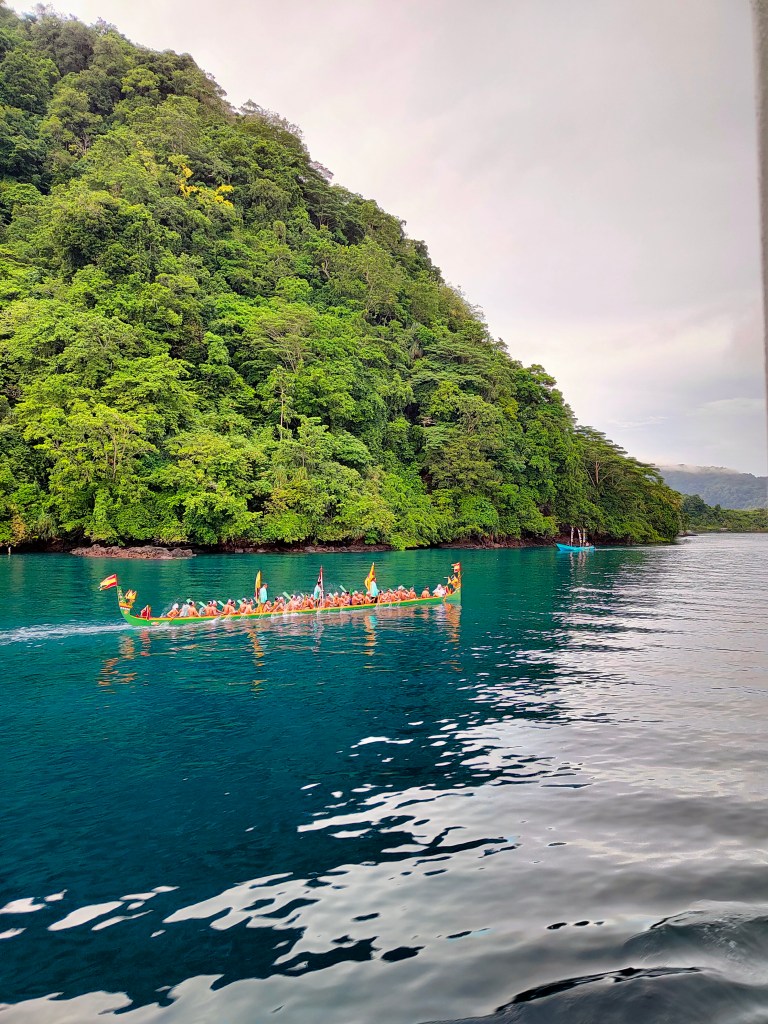
Distant drums thumped,
echoing across the dark sea.
Majestic belang painted the waters,
greeting our ship from both sides.
Yet my heart faltered.
How should I feel when,
after 400 years,
we were about to witness
the return of the descendants of those who escaped?
The lost bloodlines,
reunited at last.

How does one tell a story
when their voice is suppressed?
How does one preserve a memory
when remembering
means re-slicing a wound
that has struggled to heal for centuries?
Is it remembrance or celebration
when the body becomes a site of memory?
Should one grieve, or make peace,
once their past is confronted?
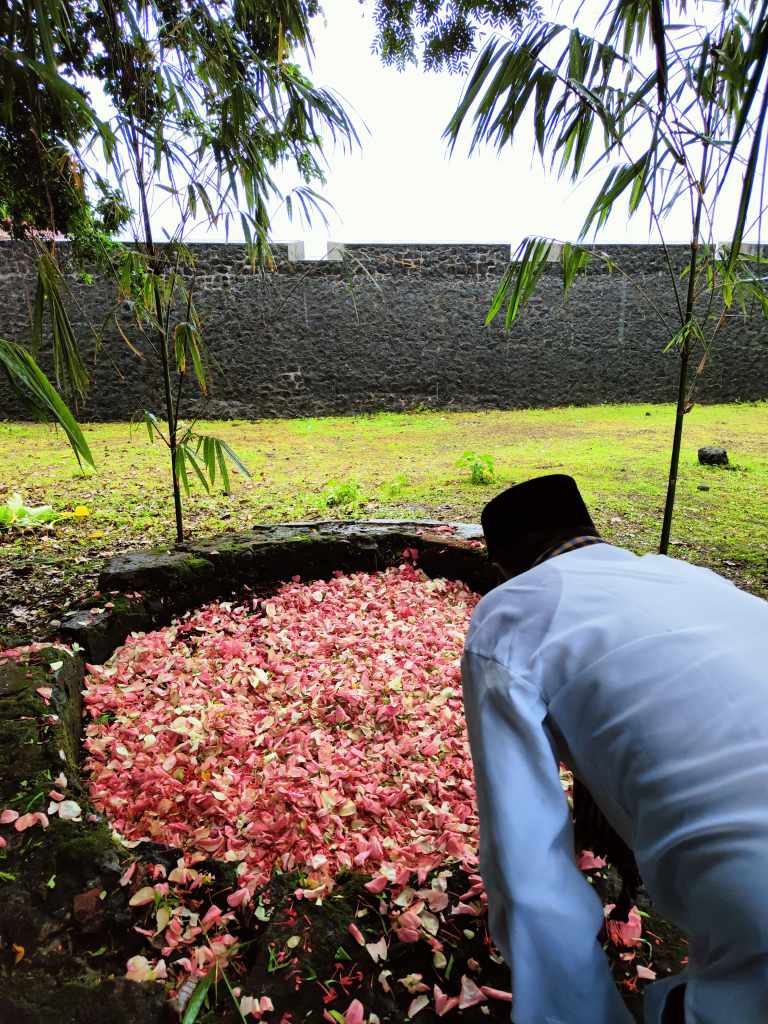
I asked myself if I had the strength
to stand by the well—
once filled with limbs instead of water.
If sites can hold memory,
and a single touch can unlock the past,
then this well might as well be hell.
And in that moment, I understood
how one becomes one with their ancestor—
through tragedy and pain.

This nibblet is innocent,
yet infused with the curse.
My teeth met smoothly,
but my tongue and nose sensed its complexity.
Deep and rich, with a touch of brightness—
dancing in a symphony of tragedy.
My mind tried making sense
of an entire people,
annihilated for a taste.
But my heart understood.
And that is why it is good—
because it is cursed.
- Long sword. ↩︎
Author’s Note
The title of this poem was inspired by Amitav Ghosh’s book title: ‘The Nutmeg’s Curse’. This poem reflects on my historical journey in 2022 to the Banda Islands, where the descendants of those displaced by the 17th-century Banda Massacre returned for the first time as a whole community from Banda Eli to reconnect with their lost homeland. I was very fortunate to witness this monumental event when I was participating in the Spice Route by the Indonesian government. The Dutch East India Company (VOC) wiped out most of the Bandanese to monopolize nutmeg—leaving behind a land heavy with memory. Standing there, I felt the weight of history and the eerie truth that the spice behind so much loss still lingers in our kitchens, on our tongues, in our collective past. Fig 1 shows a painting based on the oral tradition preserved by Bandanese women to the finest, most graphic details. It also highlighted the involvement of Japanese mercenaries or Ronin hired by the Dutch East India Company. Fig 5 shows cakalele, a dance that re-enacts and interprets the war and genocide. Somewhat identical to the scene portrayed in the painting, with bamboo poles and women standing in the back as witnesses of the tragedy. Fig 6 shows an old man touching the well where the limbs of the martyrs were thrown into after the genocide. The photo was taken after a morning prayer ceremony for the martyrs.
Biography
Mohammad Resyad Ghifari is a food anthropologist and writer exploring the intersections of taste, history, and memory. His work examines colonial legacies, migration, and cultural heritage, from the Indonesian spice route’s reimagination to heritage tourism dilemmas. He studied Food Science at Universiti Putra Malaysia and recently graduated with an MA in Anthropology of Food and Arabic at SOAS University of London. His research spans digital ethnography and the politics of remembrance, often reflecting on how food serves as both a site of survival and historical reckoning.
 gradfoodstudies.org